
5 Reasons to Consider Silver Now

In an era of economic uncertainty and fluctuating markets, silver emerges as a beacon of growth potential and stability. This industrial and precious metal offers unique advantages that may make it a compelling investment choice right now.

1. Supply Constraints

2025 marked one of the largest market deficits of silver in more than 20 years and 2026 is expected to be the sixth consecutive year of supply shortfall.1

As a natural resource attained primarily through mining operations, it takes a significant investment in time and resources as well as approvals and permits from local governments to mine silver. This situation makes it difficult to quickly increase supply and barriers to entry are high.

Constrained supply, coupled with rising demand has created an imbalance and set the stage for significant price growth potential.

Silver’s demand is expected to outpace supply by 67 million ounces in 2025.

2. Booming Industrial Demand

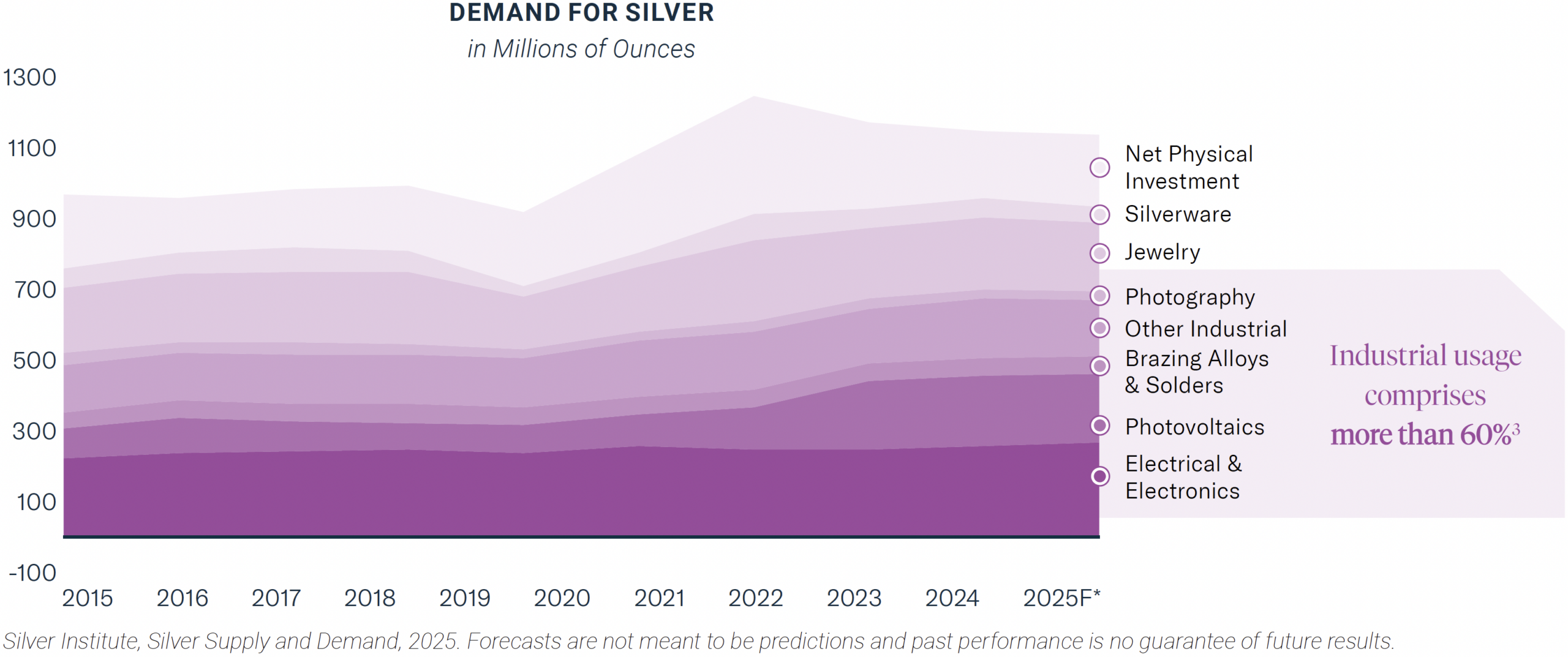
Silver isn’t just a precious metal; it’s the world’s best electrical conductor, consequently, it has been difficult to substitute. This helps explain why its industrial demand grew by over 55% between 2015-2024.2

The latest data available shows how the demand for silver has been pushed higher by industrial applications.

Key industrial use cases:

Cloud Computing
Power & AI

Solar Panels

Electric vehicles (EVs)

Cell Phones

Medical Devices

3. Safe Haven Asset

Silver has historically been viewed as a safe haven asset because it retains its intrinsic value during economic uncertainty, acting as a hedge against inflation and devaluation. As the cost of living rises, fiat currencies can lose purchasing power, and with inflationary pressures mounting globally, silver may provide a strong hedge against inflation. Its historical stability and industrial demand further bolster its appeal as a reliable store of wealth in turbulent times.

4. Affordable Entry Point

Silver presents a more attainable investment option compared to gold, offering broader accessibility for investors. Currently undervalued relative to gold, silver often mirrors gold’s price movements, making it a potentially compelling choice for those seeking to capitalize on precious metal trends.

5. Portfolio Diversification

Silver’s typically low correlation with traditional assets such as stocks and bonds makes it an excellent diversification tool. Its safe haven role may also help to stabilize portfolios during market volatility, supporting balanced growth.


Conclusion

Looking ahead, the outlook for silver in 2026 is bright given the demand for it in industrial production and as a store of value as a precious metal. Forecasts indicate a continued supply shortage in 2026 and economic and geopolitical uncertainty along with potential rate cuts could add yet another tailwind to silver prices.

You can get involved, here's how:

Amplify Junior Silver Miners ETF

SILJ provides exposure to silver by investing in junior silver miners. Shares of silver miners typically have a high beta4, both up and down, to the price of silver.

Amplify SILJ Junior Silver Miners Covered Call ETF

SLJY targets 18% annual covered call option income and capital appreciation via junior silver miner exposure.

1Global Silver Investment to Remain Strong in 2026 Against the Backdrop of a Sixth Consecutive Annual Market Deficit I The Silver Institute, 2/10/26
2www.visualcapitalist.com/sp/visualized-the-demandfor-silver-over-time-2024f/. 1/30/25.
3World Silver Survey 2025 I The Silver Institute and Metals Focus.
4Beta measures how an asset’s returns move relative to a benchmark.
*F is the forecasted amount

Narrowly focused investments typically exhibit higher volatility. Investments in foreign securities involve political, economic and currency risks, greater volatility and differences in accounting methods. The Fund is non-diversified, making it more vulnerable to individual issuer volatility. Additionally, funds with limited geographic diversification are generally riskier and may be negatively impacted by region-specific risks.

Investing in small-cap companies tends to involve higher price volatility and lower liquidity compared to large-cap companies. Silver-related investments carry risks due to fluctuating global silver prices and variable extraction and production costs. Privatization of entities in some foreign countries could face financial losses or risk renationalization. Additionally, economies that rely heavily on trade with key partners may be adversely affected if such trade diminishes.

There is no guarantee that distributions will be made. There is no guarantee the SLJY will achieve the Target Option Premium in any given investment period. A higher portfolio turnover will cause the Fund to incur additional transaction costs and may result in higher taxes when Shares are held in a taxable account. Option prices are volatile, influenced by asset value, rates, and policies. FLEX Options may be less liquid, making it harder to close positions at preferred times or prices. The Fund plans monthly distributions, partly as return of capital, which lowers cost basis and may increase future taxes, even if shares are sold at a loss.