

Cybersecurity: Protecting Data, Powering Growth

Why Cybersecurity Now?
The urgency for robust cybersecurity solutions has never been greater.
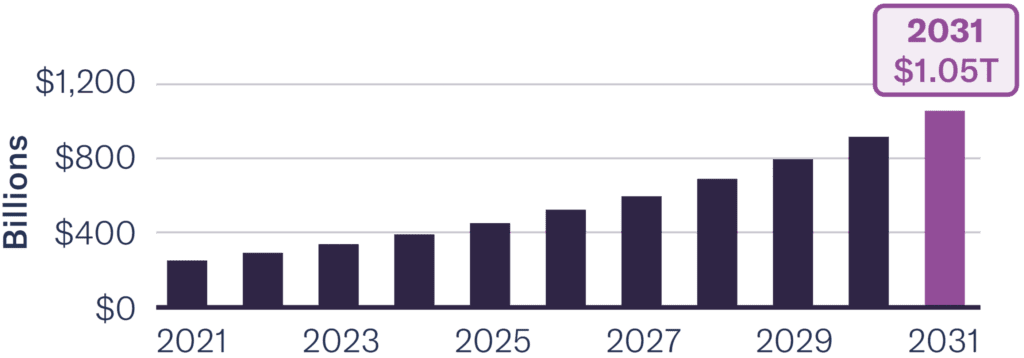
Global cybersecurity spending is projected to reach $1.05 trillion by 2031, growing at a 15% annualized rate.1
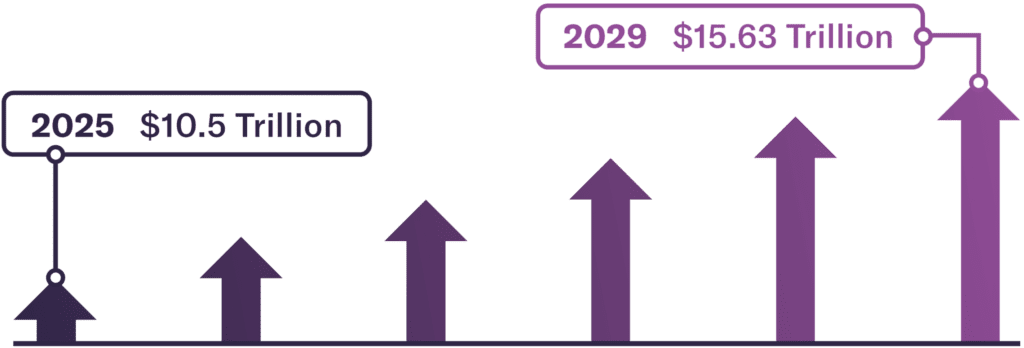
Cybercrime costs are forecast to climb from $10.5 trillion annually in 2025 to $15.63 trillion by 2029.2
Drivers of demand include Internet of Things (IoT) expansion, cloud migration, AI-powered threats and defenses, regulatory mandates, and remote work—all fueling unprecedented need for robust security solutions.

AI & Generative AI
Both accelerate attacks & enable more advanced defenses.

Cloud Migration
Widens the attack surface & demands new security strategies.

Remote Work
Expands risk, making secure access and endpoint protection a must.

Regulatory Tailwinds
SEC, Department of Defense (DoD), & global mandates require increased spending.

IoT & Digital Transformation
More devices, more risk, more need for protection.

Rising Threats
Surging in scale and sophistication, driving costs to record highs.
Resilient Revenue Models3
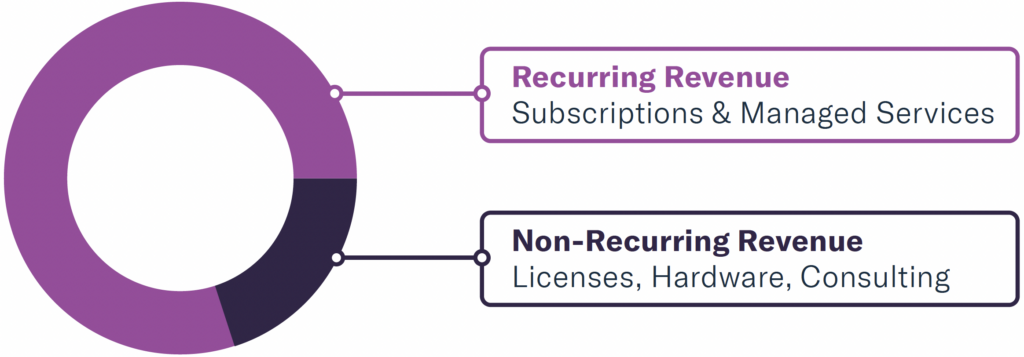
Cybersecurity companies generate 75–85% of revenue from recurring sources (subscriptions & managed services), providing utility-like cash flows even in volatile markets.
Security is a must-have budget line worldwide, with industry-leading retention and net expansion driving longterm value.
The Future Threat Landscape4
Attacks are faster and smarter: average breakout time is 48 minutes, with AI enabling both attackers and defenders.

Attacks are faster and smarter: average breakout time is 48 minutes, with AI enabling both attackers and defenders.

Vishing (voice phishing) up 442% in 2024; 79% of attacks are now malware-free.

Regulatory mandates are rapidly reshaping cybersecurity strategy, demanding faster action and deeper investment.

Understanding Cybersecurity’s Role in Modern Portfolios
Cybersecurity is more than a tech trend—it’s a necessity. As digital threats rise and regulations tighten, demand for protection is surging. Adding cybersecurity exposure may help strengthen and diversify your portfolio.
Specialized Tech Sector
Focused on cybersecurity, supported by steady corporate investment and less sensitive to economic cycles.
Distinct Market Behavior
May offer diversification, historically behaving differently than traditional tech or growth stocks.
Resilient Demand
Cybersecurity spending has remained strong even during tech slowdowns or economic uncertainty.
Volatility Opportunity
In times of geopolitical tension or increased cyber threats, cybersecurity stocks may outperform broader tech.
You can get involved, here's how:
Amplify Cybersecurity ETF
- Significant Growth Opportunity: Projected at $454 billion in 2025, the global cybersecurity market is expected to hit over $1 trillion by 2031, expanding at nearly a 15% CAGR.5
- Defense Spending on Cybersecurity Is Growing: Cyber expenditures accounted for nearly a quarter—21%—of the DoD’s IT spend in FY25.6
- The Interconnected World: The increasing interconnectedness of the world through technology has led to a rising demand for robust security measures.
Amplify HACK Cybersecurity Covered Call ETF
- High Target Income: HAKY targets 15% or greater annual covered call option premium7 income.
- Cybersecurity Upside Capture: HAKY pursues price appreciation via cybersecurity companies.
- Risk Management & Diversification: Covered calls in HAKY may provide an income cushion in volatile markets and enhance diversification beyond traditional fixed-income sources.
1 einnews.com/pr_news/807326191/global-cybersecurity-market-to-reach-1-trillion-annually-by-2031
2 vikingcloud.com/blog/cybersecurity-statistics#1
3 Amplify research based on the following resources–Mordor Intelligence, Finro Financial Consulting, Best Growth Stocks, First Analysis, High Alpha & OpenView SaaS Benchmarks Reports (2024–2025).
4 CrowdStrike Global Threat Report, 2025.
5 https://www.einnews.com/pr_news/807326191/global-security-market-to-reach-1-trillion-annually-by-2031. CAGR is the compound annual growth rate
6 Department of Defense (DoD). Deltek. (n.d.). Defense FY 2026 IT and cyberspace activities: Budget highlights, 2025.
7 An option premium is the cost an option buyer pays to the seller for the right to trade an asset at a set price within a certain period.
Target annualized option premium may vary significantly and will depend on the NAV of the Fund each time the Fund sells the option contracts; actual premiums may be materially higher or lower than the stated target. Distributions are not guaranteed.
Cybersecurity companies are concentrated in the technology sector, which can be volatile and face intense competition, rapid innovation, and reliance on intellectual property. Foreign investments carry political, economic, and currency risks. The funds are non-diversified and may hold smaller companies with limited liquidity and higher volatility. HACK performance may differ from the index, and sampling can lead to tracking error.
HAKY: The Fund is actively-managed, and its performance reflects investment decisions that the Adviser makes for the Fund. Covered call strategies may limit upside potential while still exposing the Fund to downside risk. Covered puts can incur substantial losses if the underlying asset rises sharply, with premiums offering limited protection. Monthly distributions may include return of capital, which lowers the investor’s cost basis and could result in higher loss.