


Overview
Why Invest in IBUY ETF?
- Significant Growth Opportunity: Global e-commerce sales are projected to grow by more than 31%, rising from $6.00 trillion in 2024 to $7.88 trillion by 2028.1
- E-commerce Transition: Unprecedented mobile device usage is helping drive e-commerce, with smartphones accounting for 68% of online shopping orders.2
- Diversification Potential: IBUY provides innovative exposure to global online retail companies across countries, market capitalizations, and industries.
Objective & Strategy
The Amplify Online Retail ETF (IBUY) seeks to provide investment results that, before fees and expenses, correspond generally to the price performance of the EQM Online Retail Index. The index is a globally diverse basket of publicly-traded companies with significant revenue from the online retail business: traditional online retail; online travel; online marketplace; and omni channel retail.

Key Information
Fund Details
| Ticker | IBUY |
| Launch Date | 04/20/2016 |
| Primary Exchange | NYSE Arca |
| CUSIP | 032108102 |
| Net Assets | $119,511,075 |
| Shares Outstanding | 1,800,000 |
| Holdings (view all holdings) | 83 |
| Total Expense Ratio i | 0.65% |
Index Details
| Index Name | EQM Online Retail Index |
| Index Ticker | IBUYXT |
| Index Provider | EQM Indexes |
| Weighting Methodology | Modified Equal Weight |
| Rebalance Frequency | Semi-Annual |
| Index Website | eqmindexes.com |
Selection Methodology
The EQM Online Retail Index (IBUYXT) utilizes a rules based methodology:
Global equity securities eligible for inclusion in the Index
Companies with at least 70% of revenues or minimum of $100B in annual retail sales derived from online and/or virtual sales
Companies placed in two categories:
- U.S.-based
- International-based
Companies equally-weighted within each category
Performance & Holdings
Performance
| Cumulative (%) | Annualized (%) | |||||||||
|---|---|---|---|---|---|---|---|---|---|---|
| 1MO | 3MO | 6MO | YTD | Since Inception | 1YR | 3YR | 5YR | 10YR | Since Inception | |
| NAV | -7.98% | -3.64% | 7.05% | -10.43% | 169.34% | -12.54% | 14.60% | -9.39% | 9.35% | 9.95% |
| Closing Price | -7.70% | -3.41% | 6.80% | -10.30% | 169.57% | -12.25% | 14.70% | -9.36% | 9.33% | 9.95% |
| EQM Online Retail Index | -7.96% | -3.53% | 7.36% | -10.06% | 180.47% | -12.00% | 15.26% | -9.04% | 9.76% | 10.37% |
| S&P 500 TR | -0.35% | 2.30% | 17.85% | 12.75% | 334.00% | 15.74% | 22.89% | 13.79% | 15.33% | 15.08% |
| Cumulative (%) | Annualized (%) | |||||||||
|---|---|---|---|---|---|---|---|---|---|---|
| 1MO | 3MO | 6MO | YTD | Since Inception | 1YR | 3YR | 5YR | 10YR | Since Inception | |
| NAV | -7.98% | -3.64% | 7.05% | -10.43% | 169.34% | -12.54% | 14.60% | -9.39% | 9.35% | 9.95% |
| Closing Price | -7.70% | -3.41% | 6.80% | -10.30% | 169.57% | -12.25% | 14.70% | -9.36% | 9.33% | 9.95% |
| EQM Online Retail Index | -7.96% | -3.53% | 7.36% | -10.06% | 180.47% | -12.00% | 15.26% | -9.04% | 9.76% | 10.37% |
| S&P 500 TR | -0.35% | 2.30% | 17.85% | 12.75% | 334.00% | 15.74% | 22.89% | 13.79% | 15.33% | 15.08% |
The performance data quoted represents past performance and does not guarantee future results. Investment return and principal value of an investment will fluctuate so that an investor’s shares, when sold or redeemed, may be worth more or less than the original cost. Current performance may be lower or higher than the performance quoted. Brokerage commissions will reduce returns. NAV is the sum of all its assets less any liabilities, divided by the number of shares outstanding. The closing price is the last price at which the fund traded.
The Amplify Online Retail ETF (“IBUY”) investment objective and strategy differs substantially from the market indices, which are included for comparison purposes only.
The Standard & Poor’s (S&P) 500 Total Return Index is an unmanaged, market-capitalization-weighted index of the 500 largest U.S. publicly traded companies by market value, and assumes distributions are reinvested back into the index. It does not include fees or expenses. It is not possible to invest directly in an index. The S&P 500 is a registered trademark of Standard & Poor’s Financial Services LLC, a subsidiary of The McGraw-Hill Companies, Inc.
The EQM Online Retail Index differs substantially from the S&P 500 Index, which is used for comparison purposes as a widely recognized measure of U.S. stock market performance. While the returns of IBUY have exhibited positive (but varying) correlation to the index over time, IBUY may invest in different stocks and in different proportions than in the S&P 500 index.
Top 10 Holdings
| Name | Ticker | Market Value (%) | CUSIP | Shares | Market Value ($) |
|---|---|---|---|---|---|
| Wayfair Inc | W | 3.77% | 94419L101 | 44,496 | $4,505,220 |
| MSC Industrial Direct Co Inc | MSM | 3.04% | 553530106 | 27,965 | $3,638,806 |
| Liquidity Services Inc | LQDT | 2.85% | 53635B107 | 78,901 | $3,410,890 |
| Airbnb Inc | ABNB | 2.85% | 009066101 | 20,994 | $3,410,055 |
| PayPal Holdings Inc | PYPL | 2.80% | 70450Y103 | 63,469 | $3,351,163 |
| DoorDash Inc | DASH | 2.77% | 25809K105 | 17,483 | $3,306,909 |
| Etsy Inc | ETSY | 2.75% | 29786A106 | 45,201 | $3,289,277 |
| Spotify Technology SA | SPOT | 2.73% | L8681T102 | 6,905 | $3,265,305 |
| Maplebear Inc | CART | 2.71% | 565394103 | 73,125 | $3,235,781 |
| Lyft Inc | LYFT | 2.67% | 55087P104 | 206,373 | $3,190,527 |
Fund holdings are subject to change at any time and should not be considered recommendations to buy or sell any security.
Allocation
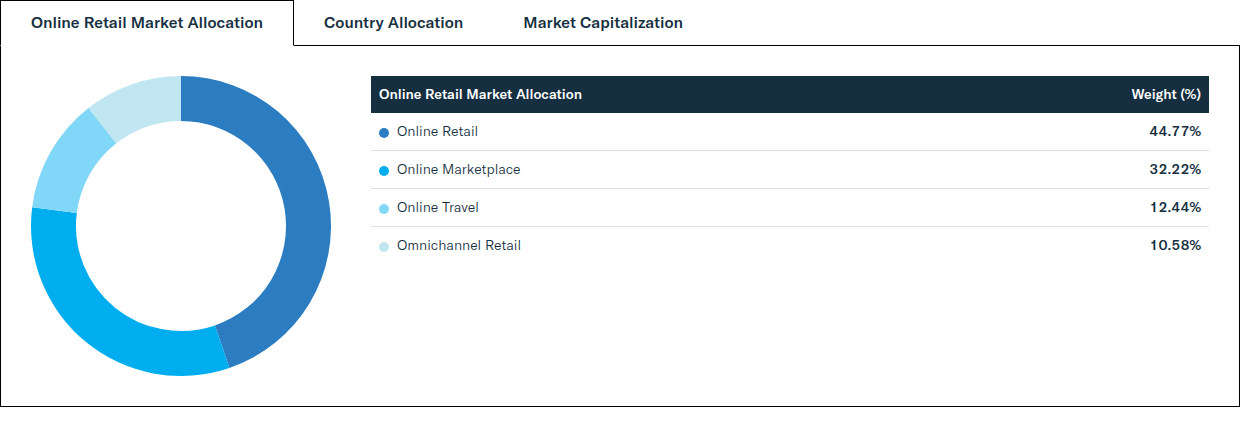
| Online Retail Market Allocation | Weight (%) |
|---|---|
| Online Retail | 44.77% |
| Online Marketplace | 32.22% |
| Online Travel | 12.44% |
| Omnichannel Retail | 10.58% |
| Market Capitalization | Weight (%) |
|---|---|
| Large Capitalization (> $10B) | 50.56% |
| Mid Capitalization ($2B - $10B) | 24.24% |
| Small Capitalization ($300M - < $2B) | 25.20% |
| Country Allocation | Weight (%) |
|---|---|
| United States | 74.45% |
| Sweden | 4.70% |
| Germany | 3.47% |
| China | 2.95% |
| Japan | 2.86% |
| Netherlands | 1.62% |
| Israel | 1.46% |
| Switzerland | 1.37% |
| Singapore | 1.27% |
| Canada | 1.25% |
| Poland | 0.80% |
| Spain | 0.78% |
| India | 0.76% |
| Uruguay | 0.64% |
| Ireland | 0.52% |
| Korea | 0.49% |
| Hong Kong | 0.48% |
| United Kingdom | 0.11% |
Distributions
| Ex-Date | Record Date | Payable Date | Amount (USD) |
|---|---|---|---|
| 12/30/2026 | 12/30/2026 | 12/31/2026 | — |
There is no guarantee that distributions will be made.
Price
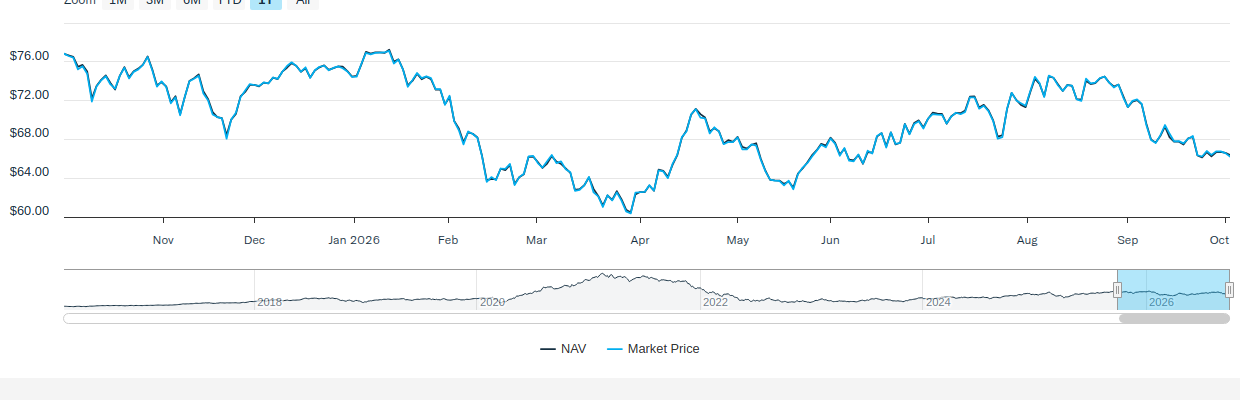
NAV/Market Price
| Previous Day's NAV | |
|---|---|
| Net Asset Value: | $66.40 |
| Daily Change: | $-0.22 |
| % Daily Change: | -0.33% |
| 30-Day Median Bid/Ask Spread: | 0.17% |
| Previous Day's Market Price | |
|---|---|
| Closing Price: | $66.23 |
| Daily Change: | $-0.36 |
| % Daily Change: | -0.54% |
| % Premium/Discount: | -0.25% |
Daily Price/NAV Performance
Premium/Discount
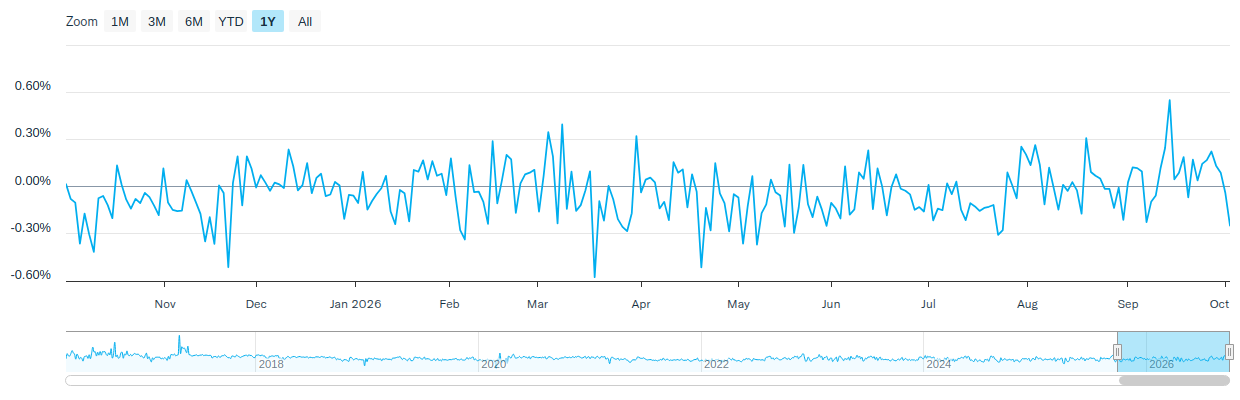
| 2025 | Q1 2026 | Q2 2026 | Q3 2026 | Q4 2026 | |
|---|---|---|---|---|---|
| Days Traded at Premium | 96 | 27 | 18 | 34 | - |
| Days Traded at NAV | 0 | 0 | 0 | 0 | - |
| Days Traded at Discount | 155 | 34 | 44 | 30 | - |
The table and line graph are provided to show the frequency at which the closing price of the Fund was at a premium (above) or discount (below) to the Fund’s daily net asset value (“NAV”). The table and line graph represent past performance and cannot be used to predict future results. Shareholders may pay more than NAV when buying Fund shares and receive less than an NAV when those shares are sold because shares are bought and sold at current market prices.
Literature
Fund Resources
Insights
Amplify Online Retail ETF (IBUY) Second Quarter Commentary 2026
August 3, 2026
The Amplify Online Retail ETF (IBUY) seeks investment results that correspond generally to the price performance of the EQM Online Retail Index. IBUY is a portfolio of companies generating significant revenue from online and virtual sales. Portfolio holdings fall into four categories: t[...]
Amplify Online Retail ETF (IBUY) First Quarter Commentary 2026
April 23, 2026
The Amplify Online Retail ETF (IBUY) seeks investment results that correspond generally to the price performance of the EQM Online Retail Index. IBUY is a portfolio of companies generating significant revenue from online and virtual sales. Portfolio holdings fall into four categories: t[...]
Amplify Online Retail ETF (IBUY) 4th Quarter Commentary 2025
January 21, 2026
Amplify Online Retail ETF (IBUY) seeks investment results that correspond generally to the price performance of the EQM Online Retail Index. IBUY is a portfolio of companies generating significant revenue from online and virtual sales. Portfolio holdings fall into four categories: traditional r[...]
How to Invest
Amplify ETFs trade throughout the day, similar to publicly-traded stocks, on an exchange. There are multiple ways to invest in Amplify ETFs:
- Contact a Financial Advisor to discover how Amplify ETFs may fit within your portfolio.
- Amplify ETFs are available through various online platforms and brokerage accounts.
Connect with your ETF Specialist or call (855) 267-3837
1https://www.emarketer.com/content/worldwide-retail-ecommerce-forecast-2025
2Statista, 5/28/25
Investing involves risk, including the possible loss of principal. Shares of any ETF are bought and sold at market price (not NAV), may trade at a discount or premium to NAV and are not individually redeemed from the Fund. Brokerage commissions will reduce returns. Narrowly focused investments typically exhibit higher volatility. A portfolio concentrated in a single industry, such as the online retail industry, makes it vulnerable to factors affecting the industry. The Fund may face more risks than if it were diversified broadly over numerous industries or sectors. Investments in consumer discretionary companies are tied closely to the performance of the overall domestic and international economy, interest rates, competition and consumer confidence.
Online retail companies are subject to risks of consumer demand and sensitivity to profit margins. Additionally technology and internet companies are subject to rapidly changing technologies; short product life cycles; fierce competition; aggressive pricing and reduced profit margins; the loss of patent, copyright and trademark protections; cyclical market patterns; evolving industry standards; and frequent new product introductions. Information technology companies may be smaller and less experienced companies, with limited product lines, markets or financial resources and fewer experienced management or marketing personnel. Stocks of many internet companies have exceptionally high price-to-earnings ratios with little or no earnings histories. Information technology company stocks, especially those which are internet related, have experienced extreme price and volume fluctuations that are often unrelated to their operating performance.
The Fund is nondiversified, meaning it may concentrate its assets in fewer individual holdings than a diversified fund. Investments in smaller companies tend to have limited liquidity and greater price volatility than large-capitalization companies. Investments in foreign securities, especially emerging markets, involve greater volatility and political, economic, and currency risks and differences in accounting methods. The Fund’s return may not match or achieve a high degree of correlation with the return of the underlying Index. To the extent the Fund utilizes a sampling approach, it may experience tracking error to a greater extent than if the Fund had sought to replicate the Index.
The EQM Online Retail Index seeks to measure the performance of global equity securities of publicly traded companies with significant revenue from the online retail business. The Index methodology is designed to result in a portfolio that has the potential for capital appreciation. The Adviser and Sub-Adviser believe that companies with significant online retail revenues may be best positioned to take advantage of growth in online retail sales and shoppers versus companies with less significant online retail revenues. Eligible constituents must operate in one of four online retail business segments: traditional online retail; online travel; online marketplace; and omnichannel retail (i.e. retail that integrates digital and physical components, including buy online/pickup in store, curbside delivery, ship from store and mobile payment in store), subject to weighting limits and other restrictions. An investment cannot be made directly in an index.
Diversification does not assure a profit or protect against a loss in a declining market.
Amplify Investments LLC serves as the investment advisor and Penserra Capital Management LLC serves as sub-adviser to the Fund.